










Madonna mia ! You Mean I Have to Live Here?


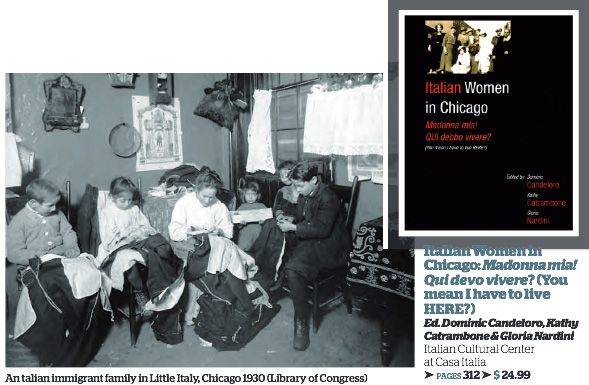
It bears worth repeating that as half of the human race, women have always “made history”. Yet their accomplishments have often been invisible. This volume focuses on the experience of Italian women who immigrated to Chicago and who made their mark on the city and Italian American women who continue to do so.
The volume is an eye-opening, diverseand immensely readablecollection of biographies,essays and creative writing thathighlights the important roles these women undertook aspoliticians, activists, musicians,writers and housewives whokept up Italian traditions.
These are women whose livesdeserve to be remembered ashistorically important and whoseexperiences and memoriescontinue to provide inspirationfor future works.Nearly fifty authors contributedto this anthology, which isdivided into two sections:“Chicago Italian Women inHistory” and “Chicago ItalianWomen in Essays, Fiction andPoetry.”
The first section includeswomen’s biographies and lifestories. In the second session wediscover how the re-discoveredstories or memories of ItalianAmerican women act as acatalyst for creative works andthe many ways these women’s lives inspire writers.
In order to produce this volume,oral history and archives werescoured to research and bring tolight the contribution of ItalianAmerican women in Chicago and their accomplishments. Somenames may be more familiarthan others: Mother Cabrini,Florence Scala and Tina de Rosa,for example. Other women are evoked through fiction and essay, as in the case of TonyArdizzone’s portrait of his grandmother in the short story“Nonna,” the personal tributeof professor Fred Gardaphé tohis mother in, “Good Mammas:The Story of One,” and Mary Jo-Bona’s essay, “The RemarkableRosa,” in which she explains whyher students are drawn to thestory of Rosa Cassettari and herrole in the Chicago Commons Settlement House. As one ofthe editors, Dominic Candeloro, reminds us in his introduction,Italian American women havecome full circle: “The big picture that emerges is a varied one.
Chicago Italian women havebeen ragpickers, needle workers, midwives, labor organizers, farmworkers, club women, countycommissioners, lawyers, doctors, dentists, writers, entrepreneurs,broadcasters, performers, homemakers, and mothers”.
The book takes us through the journey of the lives of these women who were uprooted from their agricultural communities and subjected to oppressive conditions in an urban setting.
We learn how they found community and stability thanks to organizations such as the Jane Addams Hull House and the Chicago Commons Settlement House. Benefit societies and adherence to traditions such as religious festivals and weddings provided continuity and stability. Women went to work in the 1920s, learned to make do, and made it through the Great Depression. Theyworked through the identity anxiety caused by World WarII, contributed to the success of their family business, emerged as political leaders and becameCEOs all in the span of three orfour generations. Women began to write their own stories.
In “Inventing an Identity” another of the editors, Gloria Nardini points out how “in less than thirty years Italian/American women’s writing has come a very long way”.
After being exposed to the rich array of cultural history the reader encounters in this book, the editors hope it will inspire readers to S.O.S: Save our Stories through documents and memorabilia that will help to preserve and continue to tell the stories of this important and influential group, many of them unwritten.
To contribute
to this ongoing project, contact
[email protected]
i-Italy
Facebook
Google+
This work may not be reproduced, in whole or in part, without prior written permission.
Questo lavoro non può essere riprodotto, in tutto o in parte, senza permesso scritto.