











FEED: an itinerant, interactive installment in and about public markets
Public markets have always been a primary site of complex commodity exchange, and yet, were also once known as vital cultural centers for social and political exchange within an urban setting. FEED, a migratory exhibition presented by Fragmental Museum, seeks to experimentally explore the public space within the historic Essex Street Market through the installation and performance of visual arts and cultural projects. With the aim and process in dynamic unison, we do not necessarily seek to institute new connections, but to highlight and creatively bring into focus the relationships that are already at play. These interactions--between merchant and shopper, product and consumer, artist and audience--are fluid and ever-changing.
Through fostering animated conversations and conscious experiences, FEED seeks to encourage these existing open connections; intending to better understand the patterns and implications of the myriad of ways we relate to ourselves, each other, and our environment as a whole.
This upcoming installment initiates FEED as a series of cultural recycling investigations. A collaboration between Konstantinos Stamatiou and The Very Many forms the facade of the host space, Cuchifritos Gallery, and embodies the theme of the exhibit. Through a synthesis of their related approaches to topology, this collaboration creates a sculptural cartography--a collective mapping--of the Essex Street Market. Inside, there will be a site-specific stadium by Constance Armellino & OFF Architecture, built of recycled materials and engraved with benefactors name to memorialize their (your?) endowment to FEED.
The video screening program is curated by Gabriela Galati featuring "Baby Bottle" by Baptiste Debombourg (Courtesy Galerie Patricia Dorfmann, Paris), "Pinocchio" by Luca Bolognesi (Courtesy CAR project, Bologna) and "The Bud, The Seed, The Egg" by Mores McWreath.
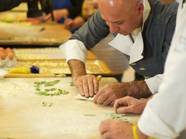
"Famine," a collective performance coordinated by Vanessa Chimera & Paolo Bertocchi, will engage the public market visitors and local merchants in a social interaction throughout the entire market. Using research from the Tenement Museum Archives, "Famine" aims to bring to life the historical migrations embedded within the food in the market and link them to global economic and political patterns. The performance takes serious issues and explores them in a fun and engaging way.
Anthropologists Chelsea Estep-Armstrong, Rachel Signer, and Julia Nevarez are collaborating to design interactive walking tours which will employ various methods of critical inquiry in order to generate new ways of thinking about food in the contexts of space and place. Additionally, they are planning dynamic lunchtime discussion panels with activists, artists, and academics who will discuss the meanings of their own work as it relates to food, creativity, collaboration, and urban space.
