PADIGLIONE ITALIA NEL MONDO-VENICE BIENNALE 2011
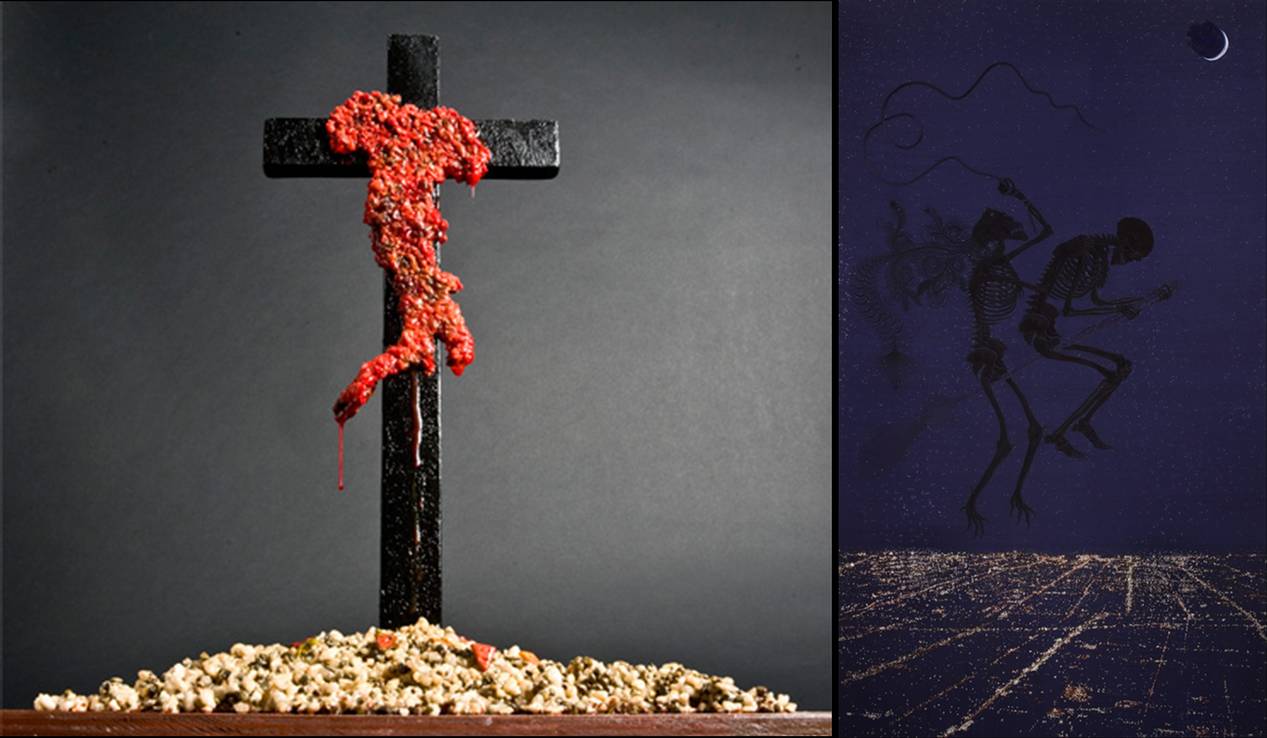
Under the umbrella project “Venice Biennale In The World” (aimed at promoting Italian contemporary artists selected by all the Italian Cultural Institutes around the world, in collaboration with the Italian Pavilion, within the Venice Biennale), the Italian Cultural Institute of New York will present a site specific installation by the Italian architect-designer Gaetano Pesce, an icon of Italian design, originality and creativity and an exhibition of recent works by the contemporary artist Angelo Filomeno.Gaetano Pesce Angelo FilomenoGaetano Pesce. From his beginnings in post-war Italy through a career that spans four decades with commissions in architecture, urban planning, interior, exhibition and industrial design, Gaetano Pesce, the architect and designer, has conceived public and private projects in the United States, Europe, Latin America and Asia, ranging from residences to gardens and corporate offices. His experience has been global, his innovations consistently groundbreaking. Pesce’s extensive body of work – recognized for its emotive and tactile qualities, unrestrained use of color, and insistence upon innovative building materials developed through new technologies – has been described by the prominent architecture critic Herbert Muschamp as “the architectural equivalent of a brainstorm.”Pesce’s multi-disciplinary works are in the permanent collections of the Museum of Modern Art and the Metropolitan Museum of Art in New York, the Victoria and Albert Museum in London, the Centre Georges Pompidou in Paris, Germany’s Vitra Museum, the Montreal Museum of Art, as well as museums in Japan, Portugal and Finland. He received the prestigious Chrysler Award for Innovation and Design in 1993, the Architektur and Wohnen Designer of the Year in 2006 and the Lawrence J. Israel Prize from the Fashion Institute of Technology in New York in 2009.Pesce’s noted museum exhibitions range from his inclusion in the legendary Museum of Modern Art exhibition “Italy: The New Domestic Landscape,” in 1972 to his 1996 career retrospective at the Centre Georges Pompidou in Paris, “Gaetano Pesce: Le Temps des Questions,” to his exhibition at the Philadelphia Museum of Art in 2005 entitled: “Pushing the Limits” and the “Gaetano Pesce: Il Rumore Del Tempo” exhibition at the 2005 Triennale di Milano. Among the companies that manufacture his designs are Cassina, B amp; B Italia, Bernini, Knoll International and Zerodisegno.Born in La Spezia, Italy in 1939, as a young man Pesce wrote a manifesto championing incoherence, in the sense of an artist’s right and necessity to change, to avoid stasis, the right to be free from ourselves, to avoid repetition. He studied at the University of Venice Faculty of Architecture between 1958 to 1963 and was a participant in Gruppo N, an early collective concerned with programmed art patterned after the Bauhaus.Pesce taught for 28 years at the Institut d’Architecture et d’Etudes Urbaines in Strasbourg, France. He has lectured at the most prominent universities and cultural institutions around the world, including Carnegie Mellon in Pittsburgh, the Domus Academy in Milan and Cooper Union in New York City, where he has made his home since 1980 after living in Venice, London, Helsinki and Paris.Boundaries between art, design and industry are irrelevant to Pesce as art is most certainly not something created and put on a pedestal, no. Art is a product; it is our creative response to the needs of the time we live in. For Pesce, true innovation requires innovation in language, material and technology. His long advocacy of and research into advanced materials yield continual innovations in form and production. Highlights include the iconic “Up” series (1969), seven pieces of biomorphic-shaped seating that were shipped deflated and flattened, but, when opened expanded into their voluptuous forms. “Up #5, La Mamma”, the first such industrial product to contain a political element, commented on the status of women by chaining the chair to its accompanying ottoman. Michael Sorkin, the New York architect and writer, calls Pesce without a doubt the best flat-out furniture designer on the planet. “He’s the real thing,” Sorkin said. “He’s got it in the brain and the wrist.”By 2002, Pesce’s “Nobody’s Perfect” line of chairs, tables, sideboards and shelves made of polyurethane elastic resins had incorporated his dictum of “diversified series:” workers’ creative choices during the manufacturing process make each piece unique in color and texture. “High tech is fantastic,” Pesce commented at a Museum of Modern Art symposium in 2009. “We can give to the market a unique piece at the cost of an industrial object.”Pesce opposes repetition, nostalgia and abstraction and embraces color, new materials, political dimensions, the “poorly made,” provocation, the feminine, the figurative, the humane and all our senses. At the I Saloni WorldWide fair in New York City in 2005 he created an Italian countryside landscape out of food and produce. There were parmesan cliffs, basil tress, polenta hills, lakes of olive oil and rivers of wine. It smelled marvelous and tasted even better. Of his work, Pesce says: “For the past forty years, I have been trying to give architecture back its capacity to be “useful to the brain,” by quoting recognizable, figurative images commonly associated with street life and popular culture. I strive to seek new materials that fit into the logic of construction, while performing services appropriate to real needs. I have tried to communicate feelings of surprise, discovery, feminity, optimism, stimulation, sensuality, generosity and joy.”Pesce’s recreation of the offices of Manhattan’s TWBA/Chiat/Day advertising agency (1995) was hailed by the New York Times as “a remarkable work of art that bears no resemblance to the sleek, hard-edged aesthetic we have come to associate with the modern world.”Pesce once remarked, “Our time is not monolithic. So if you have a building that is diversified in shape and material, it is much closer to the essence of our time.”His ongoing experimentation in building a compound in Bahia, Brazil show plans for eight inter-connected structures made of different materials, including resins, rubber, recycled glass, earth and concrete.The city of Osaka, Japan, declared Pesce’s Organic Building (1989-1993), whose façade is a vertical garden, a civic landmark in 1994.Built projects and urban studies and commissions include his proposal for Les Halles, Paris (1979); the converted Lingotto Fiat Factory, Turin (1983); the Children’s House for the Parc de la Villette, Paris (1985); the Hubin Apartment, Paris (1986); the Art Gallery in Knokke-le-Zoute, Belgium (1994); and the Shuman residence in New York City (1994).The designer has recently completed three collections for Meritalia, some of which use photographic images, a potent tool of communication, for fabric to cover the seats, sofas and stools, displaying vivid scenes of mountains, trees, clouds and waterfalls. In 2005 Pesce designed a chandelier, named “Mediteranneo,” made of 12,180 LED- Swarovski crystals that slowly change color from blue to green.Pesce is currently working on a series of shoes and apparel for Melissa, in Brazil. He designs the sole and an array of straps and coverings to choose from, allowing the wearer to customize their apparel, or as Pesce put it: “to participate in their taste.” Belts evoke crocodiles, palm trees and parrots; rings sport olives or interchangeable letters to spell out a message. For the Italian manufacturer LeFablier, Pesce is creating a table made of wooden slats and legs with a resin top; a straightforward yet sophisticated combination of the organic and synthetic.In 2009, Gaetano Pesce continued giving lectures around the world, including in Brazil, at Casa Cor, the most important Brazilian interior design fair and at the “Casa 09” event in Israel. He was an invited speaker at the Design Miami Fair. In 2009 Pesce’s work was part of several exhibitions such among them “Serie e Fuori Serie” and “Il Segno del Designers” at the Triennale Design Museum, in Milan.In 2010, Pesce presented four innovative collections at the Salone del Mobile in Milan. With long time partner Meritalia, he designed a new collection of lamps and objects called “Edizioni del Pesce”, a silicone armchair entitled “Senzafine”, and a sofa called “La Florita.” Next, with the Italian manufacturer Le Fablier, he designed a collection of resin furniture pieces called “L’Abbraccio”. Thirdly, he resumed his collaboration with Cassina, and created a new “Sansone Table” (originally from 1980) - a series of 61 pieces (tables) made in the Italian national colors: white, red and green - that when put together become a series of tables, entitled “Sessantuna,” that form the shape of the Italian peninsula, like a puzzle. Also for Cassina, Pesce created “Notturno a New York,” a revised version of his 1980 sofa “Sunset in New York.” Lastly, Pesce presented with manufacturer Elica the limited series of 15 pieces “PesceCappa,” a unique and colorful kitchen hood made of resin vegetables. Currently in 2010, Pesce’s work is featured at the Swiss Architecture Museum in Basel and the Museum of Contemporary Arts and Grand Hornu in Belgium. In July, the Italian Cultural Institute in Los Angeles showed a retrospective entitled “Gaetano Pesce: Pieces from a Larger Puzzle.” This was also the occasion for the artist to talk at the Hammer Museum in Los Angeles about his lifetime achievements.In all his work, Pesce expresses his guiding principle: that modernism is less a style than a method for interpreting the present and hinting at the future in which individuality is preserved and celebrated.Angelo Filomeno combines classical painting with the traditional craft of embroidery to create tableaus that incorporating luxurious materials—such as shantung silk, crystals, and onyx—within intricately designs. In contrast with the immediate allure of the surface, Filomeno’s embroidery paintings are filled with an array of macabre characters: skeletons, beasts, insects, limbs, body parts.Filomeno was born in Ostuni, Italy in 1963 and has lived in New York since 1992. He has participated in two major biennials: the Venice Biennale in 2007, and ARS 06 at the Kiasma Museum of Contemporary Art, Helsinki. In 2008, the Frist Center for the Visual Arts in Nashville presented Eros and Thanatos, Filomeno's first museum solo exhibition. He has been featured in numerous group exhibitions at institutions worldwide, including P.S. 1 Contemporary Art Center, Long Island City, New York; Museum of Arts and Design, New York; Site Santa Fe, New Mexico; the Blaffer Gallery, The Art Museum of the University of Houston; the 21st Century Museum of Contemporary Art, Kanazawa, Japan; and KadE Kunsthal, Amersfoort, the Netherlands. Filomeno's work can be found in several public collections, including the Centre Pompidou, Paris; 21st Century Museum of Contemporary Art, Kanazawa; 21C Museum, Louisville; and Museum of Art amp; Design, New York.Video: Filumeno e Pesce's NYC Studio